Material Handling
FIFO Lane Design Mistakes in Gravity Flow Racks
IPS Engineering Team
·
June 1, 2026
·
6 min read
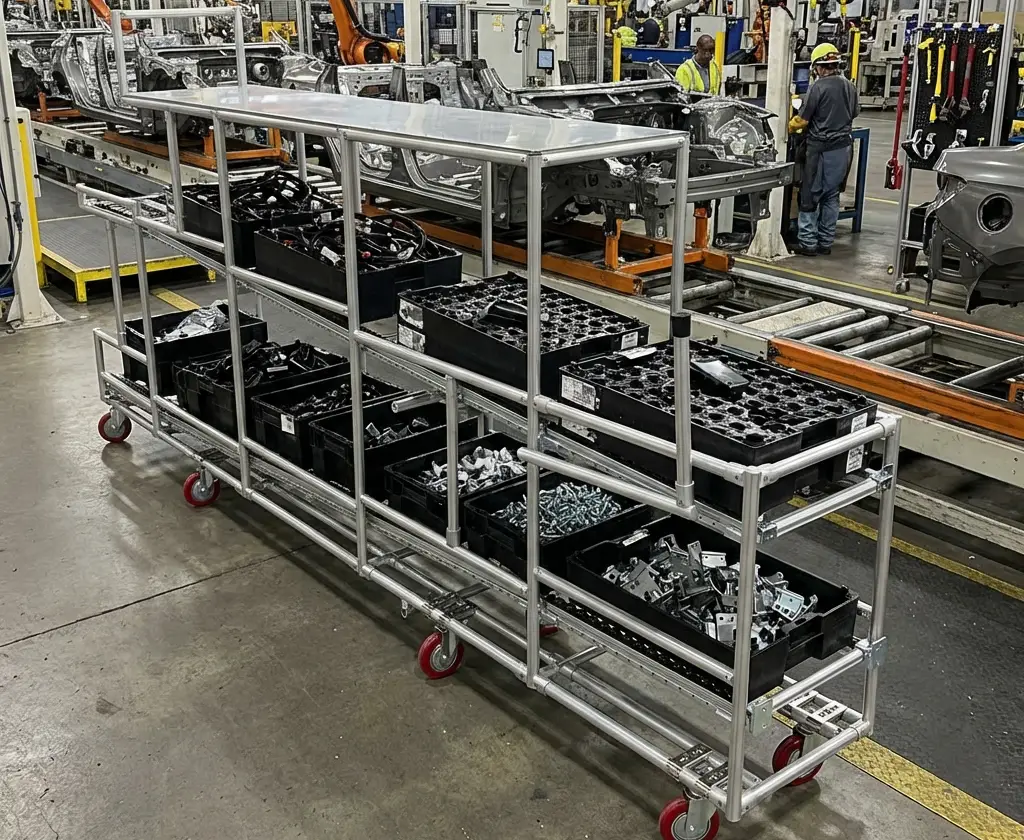
A gravity flow rack looks simple from the outside. Parts go in one end, gravity does the work, and parts come out the other end in the order they went in. That simplicity is exactly why FIFO lane design gets treated as an afterthought, and why it's one of the most common places a lean line quietly loses the time it was supposed to save.
The rack isn't the problem. The assumptions behind how it was laid out usually are. And how hard those assumptions are to fix later often comes down to whether the system was ever designed to be changed in the first place. In today's blog post, we take a look at the four biggest mistakes when in FIFO lane design.
01
Mistake #1: Designing for the part, not the variation in the part
A FIFO lane gets sized around a part's nominal dimensions, the number on the drawing. But parts vary. Tolerance stackups, packaging changes, a supplier swap that shifts a dimension by a few millimeters without anyone updating the line documentation. A lane that works perfectly for the part as specced can start jamming intermittently for the part as it actually arrives.
This isn't hypothetical. IPS regularly sees it on racks already in the field: a customer's packaging changes mid-production cycle, and a lane that ran correctly for months suddenly doesn't fit right. On a modular system, that's a lane-width or track adjustment. On a fixed, welded structure, the same change means cutting and re-welding: downtime and a fabrication order for a problem that's really just a dimension shift.
The rack isn't the problem. The assumptions behind how it was laid out usually are.
02
Mistake #2: No accounting for replenishment timing
A FIFO lane's whole job is to keep parts moving to the operator without the operator waiting. But the lane is only as good as what refills it. If replenishment cadence doesn't match consumption rate, even by a small margin, the lane either starves (operator waits) or backs up (parts get staged out of sequence to make room).
This is where a lot of "the rack is the problem" complaints actually trace back to a scheduling or material handling issue upstream, not the rack itself. But a rigid rack still constrains the fix. If the real solution is adding a lane, splitting a feed point, or changing lane depth to buffer more inventory, a fixed structure means re-fabrication. A modular system can absorb that same fix as a reconfiguration, not a rebuild.
This mismatch is easy to miss at design time because replenishment cadence and consumption rate are usually planned by different people, on different assumptions, at different points in a project. Line balancing sets the consumption side. Materials or supply chain sets the replenishment side. A lane gets sized once, early, often before either side has fully settled, and then has to live with whatever gap opens up between the two once the line is actually running at real takt time instead of planned takt time.
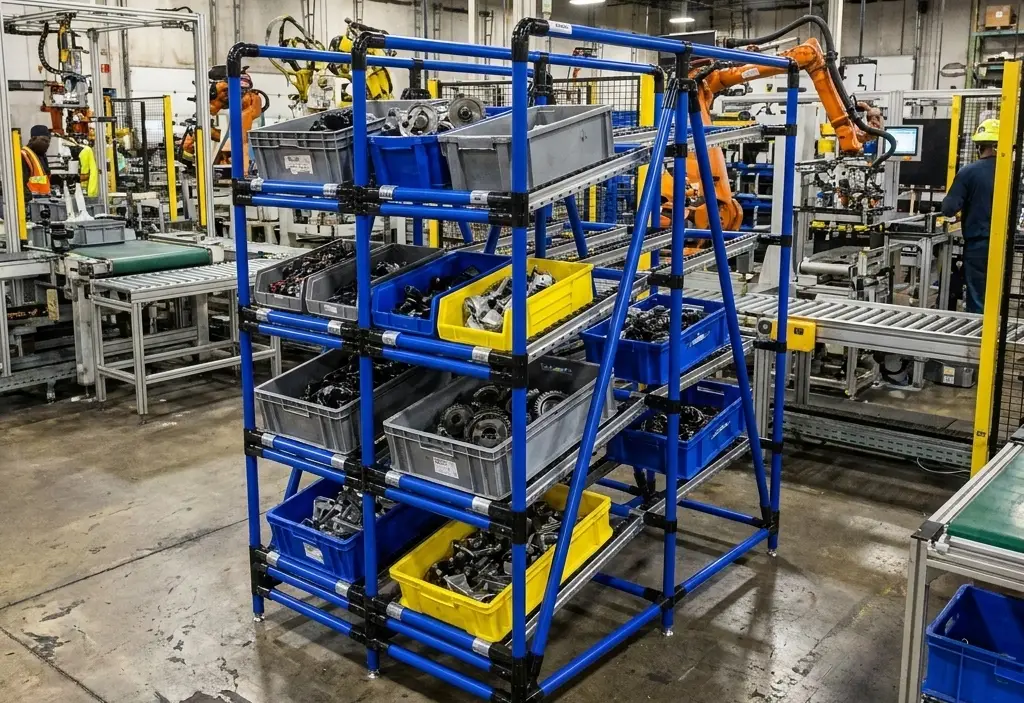
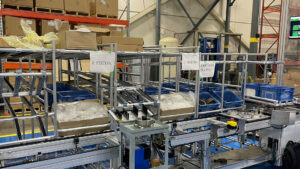
Modular gravity flow rack with FIFO lanes for line-side parts delivery.
03
Mistake #3: Ignoring pick sequence until after installation
FIFO only works if "first in" and "first needed" are the same thing. If the lane is built before pick sequence is fully mapped, or if pick sequence changes after a line rebalance, a new SKU mix, or a takt time adjustment, the rack can end up enforcing an order that no longer matches how the line actually consumes parts.
This is arguably where the modular-versus-rigid difference matters most. Pick sequence is one of the most likely things to change over a rack's lifetime, since it's downstream of decisions that have nothing to do with material handling: a new product variant, a line rebalance, a customer volume shift. A welded structure locks in whatever sequence was true on install day.
This is a pattern IPS sees often enough to be routine. Automotive Tier-1 suppliers come to us specifically to replace existing welded racks, because a sequence or layout change that should have been a quick adjustment instead required scrapping and rebuilding the structure. A modular system absorbs that same change as a reconfiguration. No capital project, no maintenance shutdown.
It's worth understanding why automotive specifically has so little tolerance for this kind of disruption. Industry research on manufacturing downtime consistently puts automotive line stoppages at roughly $2.3 million per hour, reflecting how tightly just-in-time supply chains are coupled together. A single FIFO lane rarely causes a full line stoppage on its own, but that same tight coupling is exactly what turns a lane that's quietly running wrong into a bigger problem than it looks like on the surface.
If a sequence or layout change is what's driving you to consider replacing an existing rack, this is worth a conversation before you commit to another fixed structure.
04
Mistake #4 : Underestimating what "temporary" costs later
A lane that's slightly wrong rarely gets flagged as a real problem on day one. It gets a workaround: an operator manually reordering parts, a supervisor adjusting replenishment by feel, a maintenance tech shimming something to stop an intermittent jam. Those workarounds become permanent, invisible inefficiencies that never show up as a single dramatic failure, just a slow accumulation of wasted motion and WIP.
Workarounds tend to stick around longest on rigid systems, precisely because the real fix looks like a project: cutting steel, waiting on a fabricator, scheduling downtime, rather than an adjustment. When the correct fix is cheap and fast to make, it's far more likely to actually get made instead of patched around indefinitely.
The other reason workarounds stick is that they rarely get formally logged anywhere. A shim, a manual reorder step, a supervisor's mental note to "watch that lane" doesn't show up on a downtime report or a maintenance ticket the way an actual failure does. It just becomes tribal knowledge, carried by whoever happens to be on shift, until that person leaves or the workaround itself eventually fails in a way that finally does get noticed. By then it's been quietly costing time for months, sometimes years, without ever once looking like a problem worth escalating.
If any of this sounds like a workaround your line is currently living with, it's worth finding out whether the fix is actually as involved as it looks. See how IPS approaches gravity flow rack design.
Why this is harder to get right than it looks
None of these four mistakes come from a lack of effort. They come from the fact that a FIFO lane sits at the intersection of part tolerance, replenishment logistics, and pick sequence, three things that are each someone else's responsibility on most lines, and that rarely get reviewed together until something's already gone wrong.
That's the real argument for two things at once: having the lane designed by someone who's seen these failure modes before, and building it on a system that can absorb the correction when, not if, one of these assumptions turns out to be wrong. A rack that's "close enough" on paper can still generate stockouts, WIP creep, and operator workarounds that cost far more than the rack itself. And a rack that can't be corrected without a re-fabrication order turns a normal mid-life adjustment into a capital project.
Talk To A Specialist
If your line is dealing with intermittent stockouts, WIP buildup, or operator workarounds around a gravity flow lane, it's worth finding out what's actually driving it, and whether your current system can even be corrected without starting over.
Talk to a Lean Manufacturing Specialist →