Material Handling
Assembly Workstation Mistakes on Multi-Shift Lines
IPS Engineering Team
·
June 15, 2026
·
7 min read
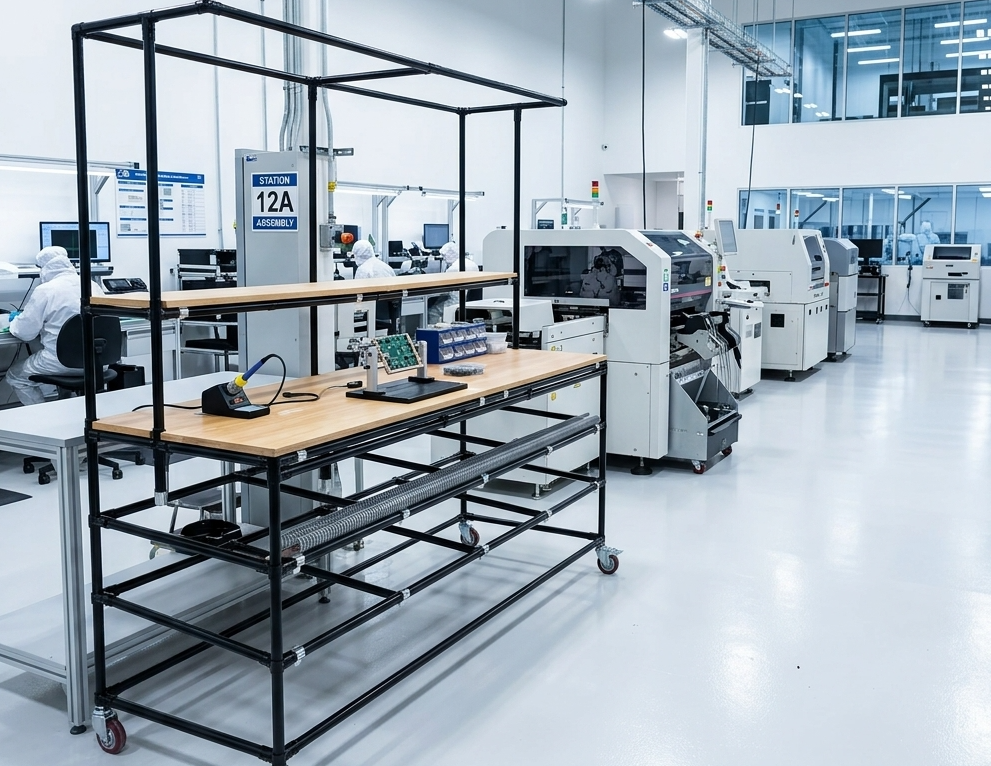
Picture the same assembly workstation at 6 AM, 2 PM, and 10 PM. Same fixtures, same tools, same footprint on the floor. A different operator each shift, different height, different reach, different way of standing at the bench for eight straight hours. Most workstations get designed once, for whoever's on the floor the day the line is commissioned, and then quietly expected to keep fitting everyone who works there after.
They don't. Not because the design was careless, but because "fits the operator" was only ever true for one of the operators who'd eventually use it.
01
Mistake #1: Designing around "the operator," not the range of operators
A workstation spec built around a single reference height treats the person present at design time as representative of everyone who'll ever use the station. On a single-shift line with a stable crew, that assumption mostly holds. On a multi-shift line, it almost never does. The station gets designed once and then has to serve a rotating cast of people it was never actually built for.
The mismatch rarely announces itself as a real problem. It shows up as an operator standing on a pallet to reach something, hunching to work below where their hands naturally sit, or just tolerating a station that's a little off for an entire shift. None of that trips an alarm on its own. It's easy to miss because it fails a little, for a lot of people, over a long time, which is exactly the kind of problem that's hard to catch during a walkthrough and easy to catch in a workers' comp report a year later.
"Fits the operator" was only ever true for one of the operators who'd eventually use it.
It also compounds in a way that's specific to multi-shift operations. A single-shift line has one crew learning one station's quirks over time, developing their own small workarounds for whatever's slightly off. A multi-shift line resets that learning every eight or twelve hours. Whatever accommodation the first shift's operator figured out for themselves doesn't transfer to the second or third shift, because each of those operators is dealing with the same fixed geometry from a different starting point, with no shared history of how to work around it.
02
Mistake #2: Treating height adjustment as something you bolt on later
The common fix, when this gets noticed, is adding adjustable legs to an existing fixed-height bench. It's a reasonable instinct and it's usually the wrong fix, because the leg height was never the only thing designed around one operator. Reach to fixtures, tool positioning, monitor placement, and work surface layout were all set relative to that same fixed geometry. Bolting adjustable legs onto a frame that was never designed to move changes one variable and leaves the rest fixed.
This is where IPS builds differently, and it's a real, structural difference, not a framing choice. Height adjustment on an IPS workstation is integrated into the frame itself from the start, available either powered with programmable presets or manual hand crank depending on the application, rather than added as a retrofit onto a station that was designed to be fixed. The whole station moves as a system, not just the legs underneath it.
If your line has workstations that were adjusted after the fact rather than designed to adjust from the start, it's worth a conversation about what an integrated frame actually solves that a retrofit can't.
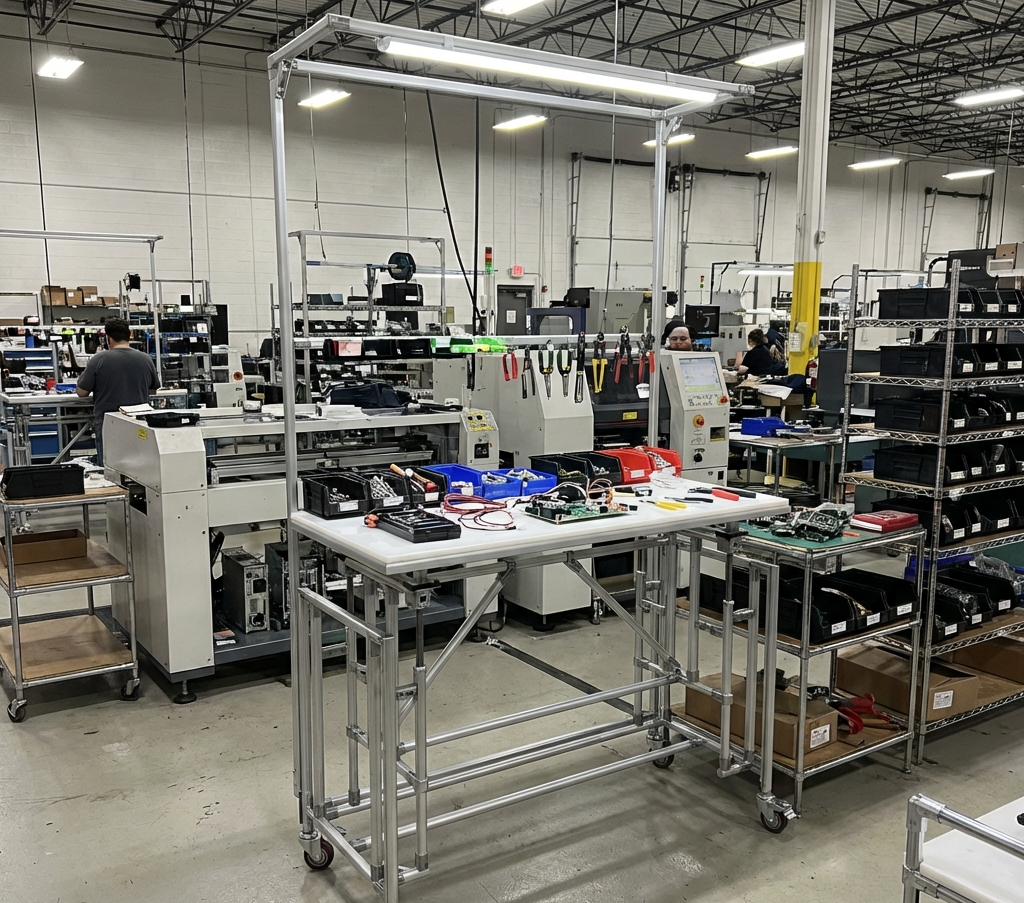
Modular AluPro workstation with height adjustment built into the frame, not bolted on afterward
03
Mistake #3: Choosing the wrong adjustment mechanism for how the line actually changes
Powered adjustment with saved presets and manual hand-crank adjustment solve different problems, and the right choice comes down mainly to how often the station actually needs to change, not just budget, though budget is a real factor too since a motorized system adds meaningful cost over a manual crank.
If a station adjusts once, at most, per shift, a hand crank is usually the right call. The adjustment happens rarely enough that the few seconds it takes isn't a real cost, and there's no reason to pay for motorized speed nobody's using. Where powered adjustment earns its cost is anywhere the station needs to change far more often than once a shift: a sit-stand station adjusted throughout the day, or a station where operators rotate in and out frequently enough that resetting to a saved preset, instantly, actually matters. At that frequency, manual adjustment stops being a minor inconvenience and starts being a real time cost, repeated often enough that it gets skipped.
Treating this as a single default choice rather than a decision tied to actual adjustment frequency is how facilities end up either overpaying for motorized speed a once-a-shift station doesn't need, or under-provisioning a station that's being adjusted constantly with a crank that can't keep up.
The pattern worth watching for is a station where adjustability exists on paper but doesn't get used in practice. A manual crank at a station that actually needs sit-stand frequency or fast operator turnover often gets adjusted once, close enough, and then left there indefinitely, because the friction of readjusting every time outweighs the perceived benefit in the moment. At that point the station is functionally back to being fixed-height, just fixed at whatever position it happened to land on, which defeats the entire purpose of specifying adjustability in the first place.
04
Mistake #4 : Underestimating what a small daily mismatch adds up to
None of this shows up as a dramatic failure. It shows up as musculoskeletal strain accumulated over thousands of repeated cycles at a station that's slightly wrong for the person using it. That's not a minor category of workplace injury. According to Bureau of Labor Statistics and National Safety Council data, musculoskeletal disorders are the single largest category of workplace injury in the U.S. and account for roughly 30% of all workers' compensation costs, a scale that reflects how much of this cost is cumulative and preventable rather than sudden and unavoidable.
An ergonomics problem that never causes a single dramatic incident can still be the largest line item on a facility's injury cost sheet, simply because it affects more people, more often, for longer, than almost anything else on the floor.
Why this is harder to get right than it looks
What ties these four together is where the assumption gets locked in. A workstation gets specified once, early, for whoever's standing on the floor that day. Everything that follows, a new shift added, a new hire taller or shorter than the last one, a product change that shifts how the station gets used, has to work with whatever got decided at that first pass. A station that's fixed at that first design point stays fixed. A station built on a frame designed to actually move with the people using it doesn't need to be redesigned every time the crew changes.
This is the same underlying issue as a fixed-height station bolted onto later, just applied to the frame instead of the legs: a rigid structure locks in whatever assumptions were true on day one, and every correction after that has to fight the original design instead of working with it. A modular frame with height adjustment engineered in from the start doesn't have that problem, because the adjustment isn't a modification, it's part of what the structure was built to do. When a new shift pattern, a new product line, or simply a taller or shorter new hire changes what the station needs to accommodate, that's a preset change or a crank turn, not a rebuild.
That's the real case for building adjustability into the structure itself rather than treating it as an accessory: it's the difference between a workstation that adapts to whoever's standing at it today, and one that has to be re-engineered every time that changes.
Talk To A Specialist
If your multi-shift line has workstations that fit some operators better than others, talk to IPS about what an ergonomic workstation designed for the whole range of people using it actually looks like.
Talk to a Lean Manufacturing Specialist →