Material Handling
Line-Side Racking: Often Overlooked But Still Has to Work
IPS Engineering Team
·
July 20, 2026
·
7 min read

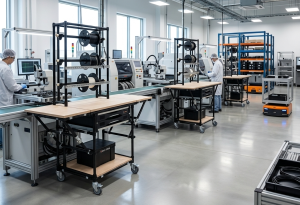
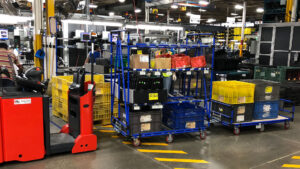
Across automotive launches and line redesigns, there's a pattern that shows up often enough to be the rule rather than the exception: line-side material handling is often overlooked in early planning. Cells get laid out, workstations get positioned, process flow gets finalized, and racking, carts, and staging get treated as the last thing worth real design attention, fit into whatever space and constraints are left over once everything else is already decided.
This isn't a planning failure. It's just how the priorities usually sequence on a real launch timeline, process engineering and cell design come first because they define what the line actually builds, and material handling is downstream of that by nature. But being last in the sequence has real consequences for what's actually possible by the time material handling gets its turn.
It's worth being precise about why this ordering happens rather than treating it as an oversight worth correcting. The cell has to exist before anyone can know exactly what needs to move where, how far, and how often. Racking and carts are, by definition, a response to a layout, not an input into deciding it. Trying to force material handling earlier in the sequence usually means designing against assumptions that change anyway once the cell is finalized. The real issue isn't the sequencing itself, it's what that sequencing demands from whatever gets built last.
Working backward from a layout that's already fixed
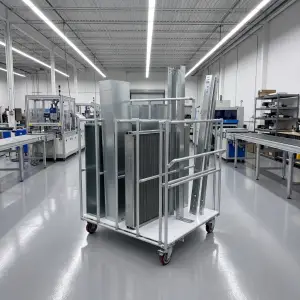
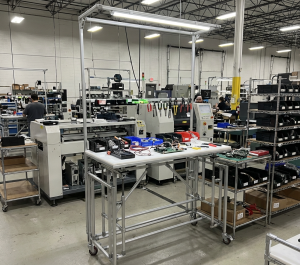
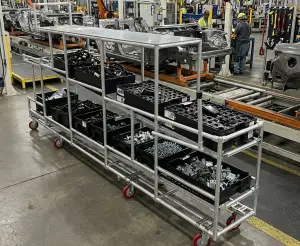
By the time racking and carts get designed, the cell footprint, the aisle widths, the equipment positions, are usually locked. That means material handling isn't being designed to an open brief, it's being designed to fit whatever space remains, often in awkward, irregular, or genuinely tight configurations that nobody planned around when the cell was laid out. A rigid, welded, or off-the-shelf solution has no ability to adapt to that kind of constraint beyond what it was originally fabricated for. A modular system, built to the actual leftover space rather than a standard footprint, is often the only practical way to make a tight, already-fixed layout actually work.
This shows up most clearly in irregular geometry, a column that wasn't accounted for, an aisle that's narrower on one side than the layout drawing suggested, an access panel that has to stay clear. A standard catalog rack or a welded structure built to a fixed drawing has no way to absorb that kind of on-the-floor reality without a redesign. A modular structure gets fit to what's actually there, including the parts of the layout that only become obvious once you're standing in the space.
Line-side material handling is often overlooked in early planning, and it still has to work under whatever's left once everything else is decided.
The problem that surfaces after racking is already designed
There's a second timing issue distinct from the layout constraint: packaging and part specifications frequently change again in the final stretch before a new launch, sometimes after racking has already been designed or even quoted against the original specs. This is a different moment than a packaging change on an already-running line months into production. It's a change that lands squarely in the gap between "racking designed" and "line launches," when there's often no schedule slack left to absorb a redesign cycle.
The timing makes this particular version of the problem harder to plan around than a mid-production packaging change. A change on a running line at least has the benefit of a working system to compare against and a maintenance window to make the fix in. A change that lands before launch has neither, the racking may not even be installed yet, there's no production baseline to test against, and the launch date usually isn't moving to accommodate a redesign cycle regardless of what changed. Whatever gets built has to absorb that kind of last-minute shift without the schedule flexing to match.
This isn't unique to racking, but it is sharply illustrated in the industry this pattern shows up in most: McKinsey's own research on automotive launch delays found that a four-month overdue launch can cost an automaker on the order of $2.3 billion in lost revenue, and identified late-stage technical changes, arriving after tooling and production plans are already committed, as one of the primary drivers. The specific numbers apply to a full vehicle launch, not a rack, but the underlying dynamic is the same one playing out at a smaller scale every time racking gets squeezed into a launch timeline that's already locked: the later a change lands relative to what's already been committed to, the more it costs to absorb, and the automotive industry's own research on this is unambiguous about where that cost actually originates.
If material handling is being brought into a launch timeline late, it's worth talking to IPS about what's actually still possible at that stage, rather than assuming the window for a proper fit has already closed.

Designed to fit the space that was left, not a standard footprint.
The constraint that isn't about space or specs at all
There's a third version of this problem, and it's less visible than the other two because it doesn't show up as a physical mismatch. Takt time, the actual rate the line needs to run at, how many seconds each station gets, is often not fully locked until fairly late in a project, even though material handling frequently gets designed against an earlier estimate of it. Replenishment cadence, rack buffer capacity, and cart routing all get sized to a takt time assumption, and if that number shifts once process engineering finishes rebalancing the line against real, validated cycle times, the racking's physical footprint might still fit perfectly while the rate it was built to deliver at no longer matches what the line actually needs.
This is a harder constraint to notice than a layout mismatch or a packaging change, because nothing about the rack looks wrong. It still fits the space, it still holds the right parts. What's off is the cadence underneath it, and that kind of mismatch tends to surface as a bottleneck or an operator wait time after launch, not as an obvious design flaw beforehand.
Why flexibility matters most for the piece designed last
This is the real argument for building racking and carts on a modular system rather than a fixed one in this specific context: the piece of the line that gets designed last, under the tightest constraints, with the least schedule slack, is also the piece most likely to need a further adjustment before or shortly after launch, whether that adjustment is a layout squeeze, a packaging change, or a takt time correction. A rigid structure designed against an already-tight brief has no room left to absorb any of the three. A modular one can flex to the constraint it was given initially and adapt again if the layout, the packaging, or the rate the line runs at shifts before the line actually starts running.
None of this is an argument that material handling should be designed earlier in every launch, that's rarely realistic given how these timelines actually work in practice. It's an argument that the structure itself should be built to handle being last in the sequence, since that's the position it's usually in regardless of how the project gets planned.
Talk To A Specialist
If your team is navigating a line redesign or new launch where material handling is being addressed late in the process, see how IPS works across industries to fit racking and workstations into constraints that are often already locked in by the time material handling gets its turn.
Talk to a Lean Manufacturing Specialist →