Material Handling
Tugger Cart vs. Push Cart vs. Mobile Flow Rack
IPS Engineering Team
·
July 13, 2026
·
6 min read
Most cart selection conversations start with the wrong question. "Which cart is best" doesn't have a clean answer, because a tugger cart and a manual push cart aren't ranked options, they're solutions to different layout problems. And sometimes the real answer isn't a cart at all. The right starting question isn't about the cart. It's how material actually needs to move through your specific facility, and what it's moving between.
When your layout wants a tugger train
A tugger system, one powered vehicle towing a train of carts, earns its cost when a single route needs to service multiple stops in a repeatable sequence: several line-side locations across a facility, refilled on a fixed cycle rather than on demand. The layout signal is a milk-run pattern, one consistent path, multiple drop points, run often enough that a single operator walking a route with a manual cart would eat a meaningful chunk of a shift just in transit time.
Where this goes wrong is applying a tugger system to a layout that doesn't actually have multiple fixed stops. A single-destination delivery doesn't benefit from a train, it just adds the complexity and cost of towing infrastructure to a job a simpler cart handles just as well.
The layout question worth asking directly is how many stops a single trip actually needs to make, and how often that trip repeats. A route with two stops run twice a shift doesn't justify a tugger train. The same two-stop route run every twenty minutes across three shifts almost certainly does, since the cumulative walking time an operator spends on manual trips adds up to a real, recurring labor cost that a tugger system converts into a single automated pass.
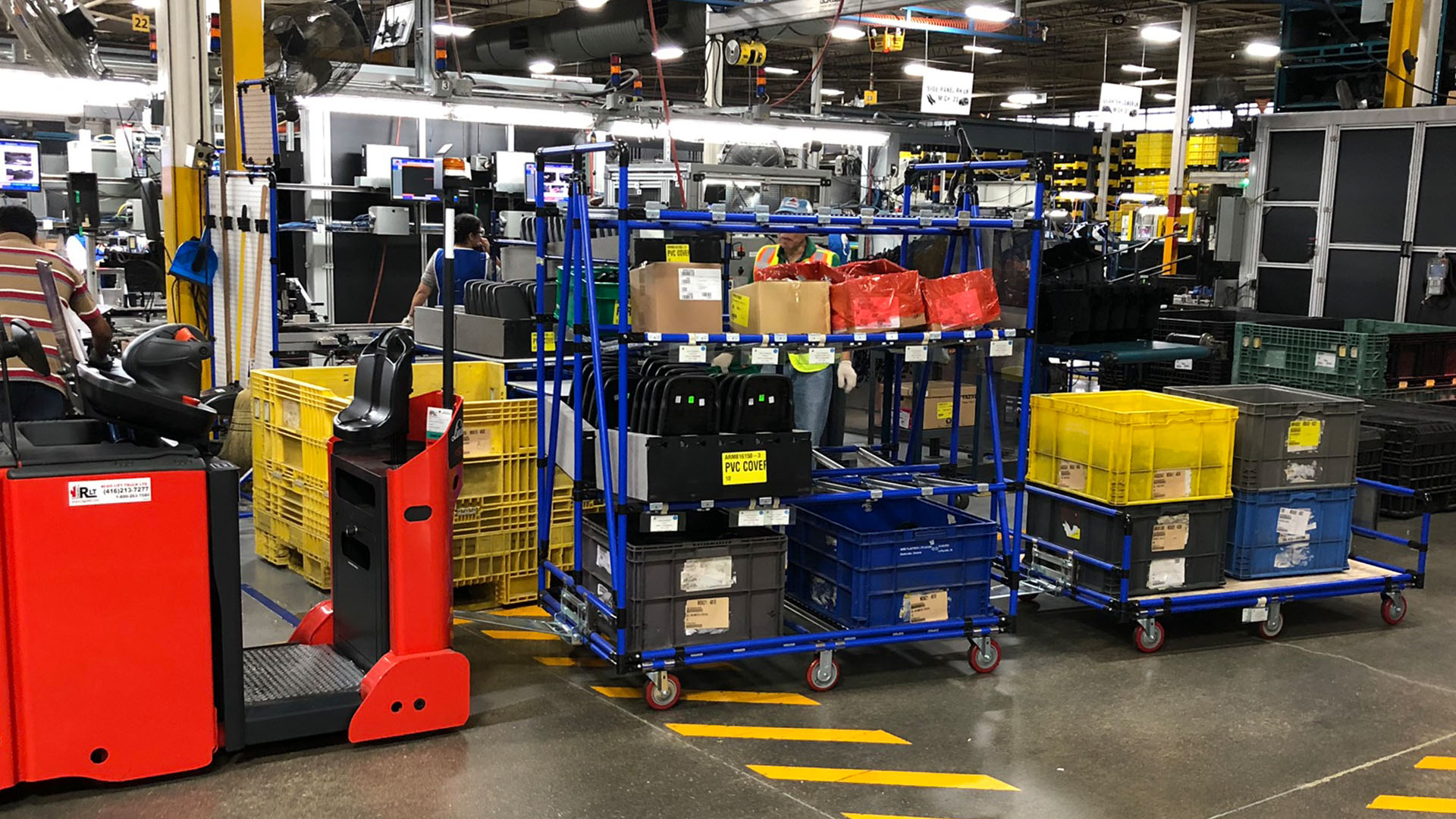
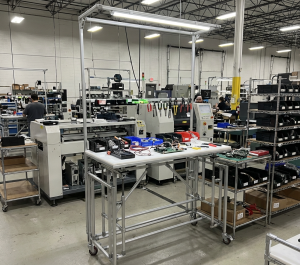
A tugger train pulls multiple carts for high frequency deliveries to the line side.
When a manual push cart is the right answer, not the fallback
It's easy to treat a manual push cart as the option you settle for when budget doesn't stretch to something more capable. That's the wrong frame. A short, flexible, low-volume delivery route, especially one without a fixed sequence of stops, is a layout that a manual cart handles correctly, not a layout it's merely tolerated on. Adding tugger infrastructure to a route that doesn't need it isn't an upgrade, it's solving a problem the layout doesn't actually have.
The layout tell here is flexibility. If the route changes week to week, or the destination varies depending on what's being built that day, a manual cart's lack of fixed infrastructure is the advantage, not the limitation.
Everything above is really about how a cart moves, not what it's built to hold. IPS also builds several different internal configurations, cubby carts for separating loose parts, flat shelving carts, and carts built specifically around bins or totes, and any of these can be pushed manually or towed in a tugger train. That's a separate decision from motive method, and worth its own dedicated look rather than folding it in here.
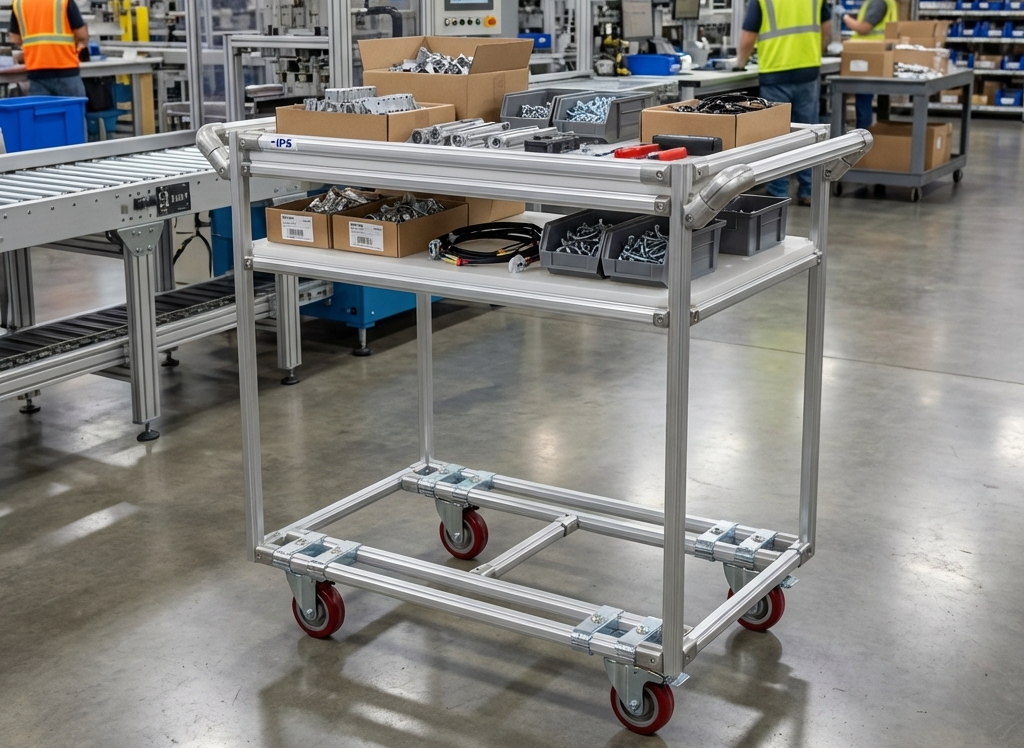
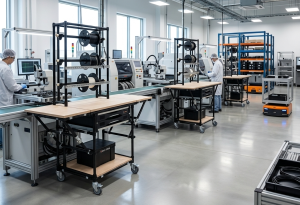
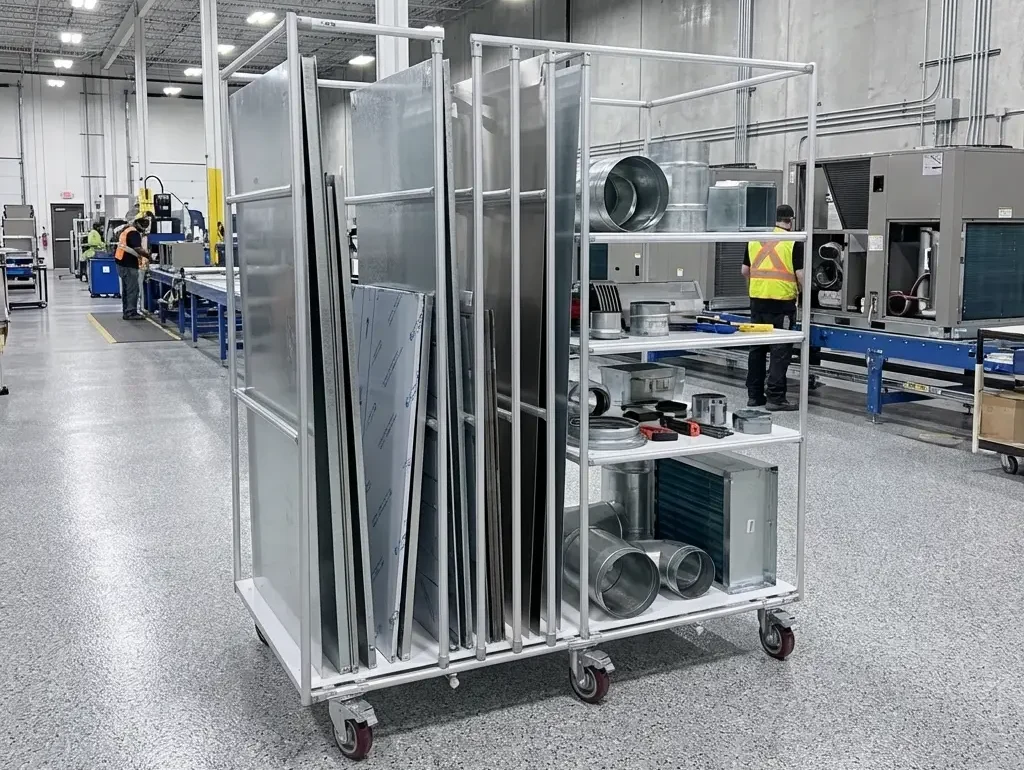
A manual push cart is an economical option when motorized options aren't necessary.
A tugger cart and a manual push cart aren't ranked options, they're solutions to different layout problems.
When what you actually need isn't a cart at all
Sometimes what looks like a cart decision is actually a different question entirely. If a location needs repeated partial picks over a dwell period, an operator returning to the same spot again and again to pull individual parts, rather than a single delivery that gets unloaded all at once, the right answer usually isn't any cart. It's a mobile gravity flow rack: a full FIFO lane system on locking casters, built to be repositioned when the line changes rather than moved on a delivery route.
The distinction matters because these solve genuinely different problems. A cart's job is transportation, getting material from point A to point B efficiently. A mobile flow rack's job is presentation, keeping parts organized and accessible at a point of use over time, with the added flexibility of not being permanently fixed to the floor. Treating a presentation problem as a transportation problem usually shows up as a cart parked semi-permanently next to a workstation, functioning as makeshift storage it was never actually designed to be.
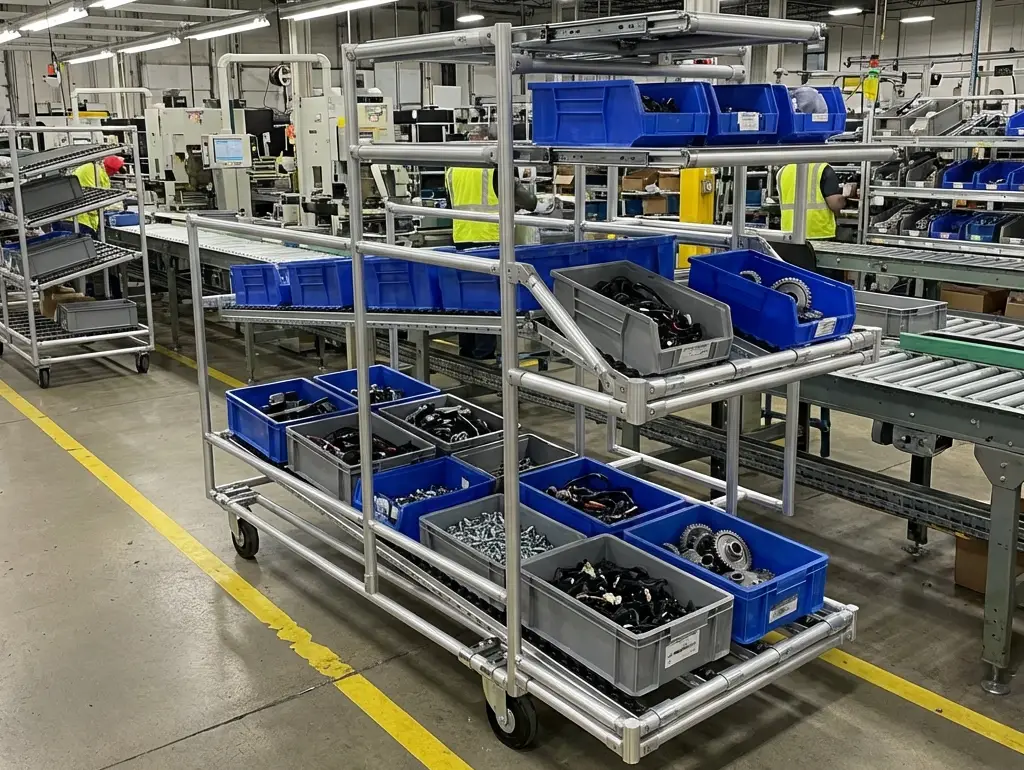
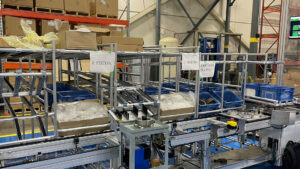
A mobile gravity flow rack on casters can move in and out of your lineside as needed.
If you're not sure which of these actually matches your layout, it's worth talking through the specifics with IPS rather than guessing from a catalog.
The scenario none of the above actually cover: docking with a stationary rack
There's a separate case worth calling out specifically: when a cart's job is to deliver directly to a stationary rack, exchanging totes or loads at the interface, rather than being unloaded by hand. For that, IPS builds what we call bump carts: carts engineered to physically dock with a stationary flow rack, transferring the load directly rather than requiring an operator to move parts from cart to rack manually.
This matters because the generic version of this problem gets solved with an extra step nobody accounted for in the original layout: a cart arrives, and someone still has to manually move totes from the cart onto the rack one at a time. A cart built to interface directly with the rack it's feeding removes that step entirely, which is a meaningfully different thing than picking a faster or cheaper cart.
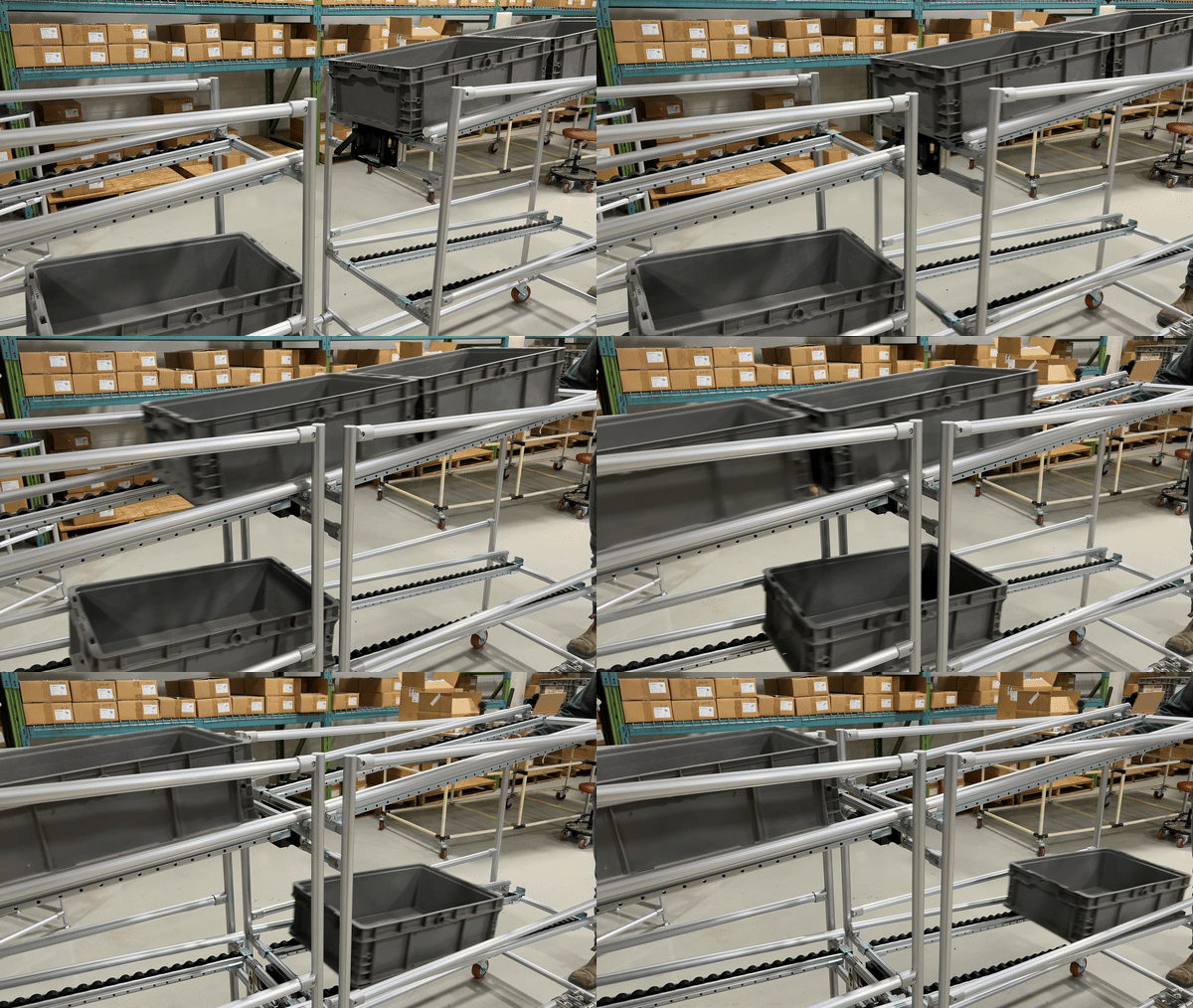
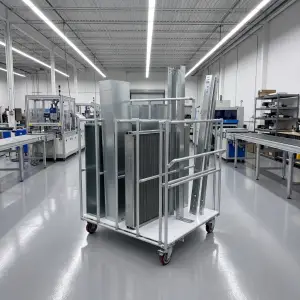
Built to interface directly with the rack it feeds, not just deliver nearby.
Why this matters beyond convenience
Getting this right connects to a bigger safety question most facilities are already trying to solve: reducing forklift dependency on the floor. OSHA's own estimates put forklift-related injuries at roughly 85 fatalities, 34,900 serious injuries, and 61,800 non-serious injuries annually in the U.S., and manufacturing carries the largest share of severe forklift incidents of any industry sector. Line-side delivery, whether by cart, tugger, or mobile flow rack, exists specifically to reduce forklift trips in exactly this kind of environment. A system that's mismatched to the actual layout doesn't just cost efficiency, it can push facilities back toward the forklift trips it was supposed to eliminate.
Matching the equipment type to the actual layout, and recognizing when the real need isn't a cart at all, is the difference between a delivery system that actually replaces forklift traffic and one that quietly gets bypassed the first time it doesn't fit the job.
Talk To A Specialist
If you're not sure whether your line needs a cart, a tugger system, or a mobile flow rack, talk to IPS about matching the right equipment to your layout.
Talk to a Lean Manufacturing Specialist →